
The Belgian Cancer Registry (BCR) has been monitoring cancer incidence in Belgium for more than 20 years. For melanoma, the most aggressive form of skin cancer, the latest data reveal several notable developments.
The risk of melanoma has more than doubled over twenty years
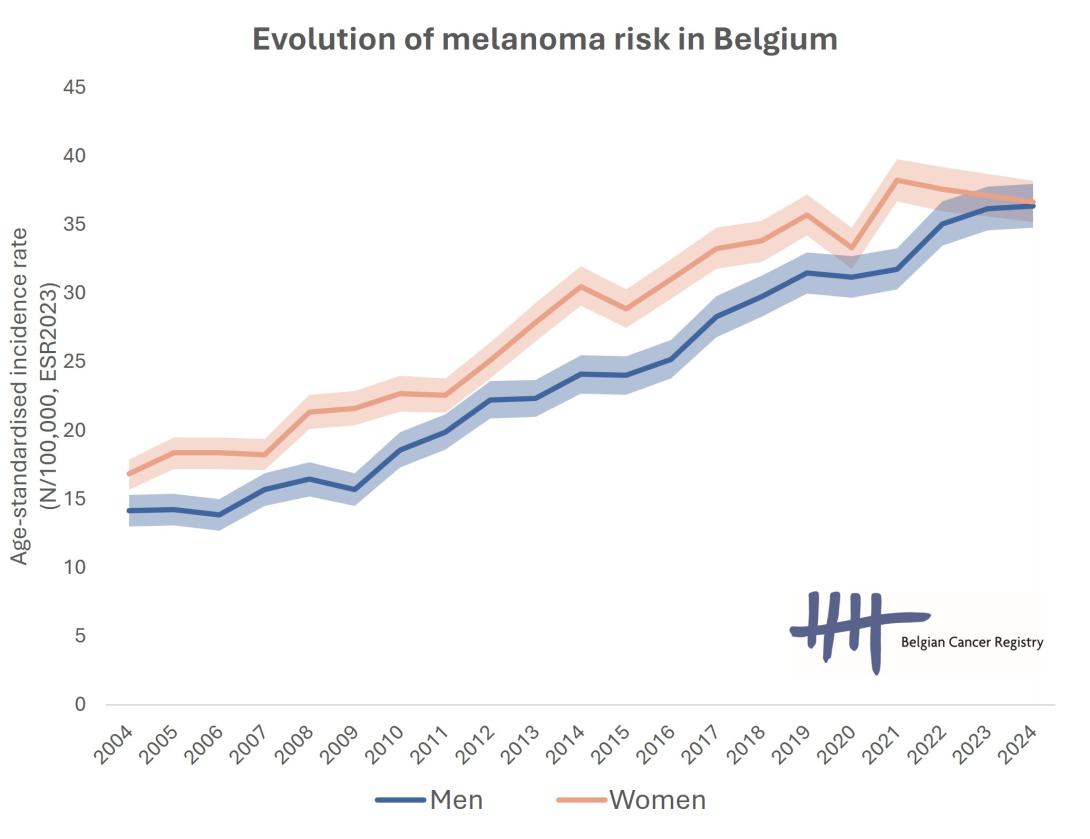
The incidence of melanoma continues to rise in Belgium. Over the past two decades, the risk of developing melanoma has more than doubled in both men and women. Among women, the risk increased by an average of more than 4% per year, while among men the increase exceeded 5% per year (Figure 1).
For the first time, melanoma risk is now equally high in women and men
In 2024, the BCR recorded 4,285 new melanoma cases, including 2,029 in men and 2,256 in women.
This increase has been accompanied by a remarkable shift in melanoma epidemiology. Between 2004 and 2023, women had, on average, a 16% higher risk of being diagnosed with melanoma than men. Over the past three years, however, the risk has stabilized among women while continuing to increase among men. As a result, after adjusting for population size and age structure, the risk of being diagnosed with melanoma is now equally high in men and women for the first time in Belgium (Figure 1).
In absolute numbers, however, women still account for slightly more melanoma diagnoses.
Prof. Pierre Coulie, Co-Chair of the Belgian Foundation Against Cancer:
"More research saves lives. That is why the Belgian Foundation Against Cancer supports scientific research aimed at developing more effective treatments. By funding innovative research projects, including melanoma research, we improve our understanding of skin cancer and enhance both survival prospects and quality of life for patients."
Important differences by age
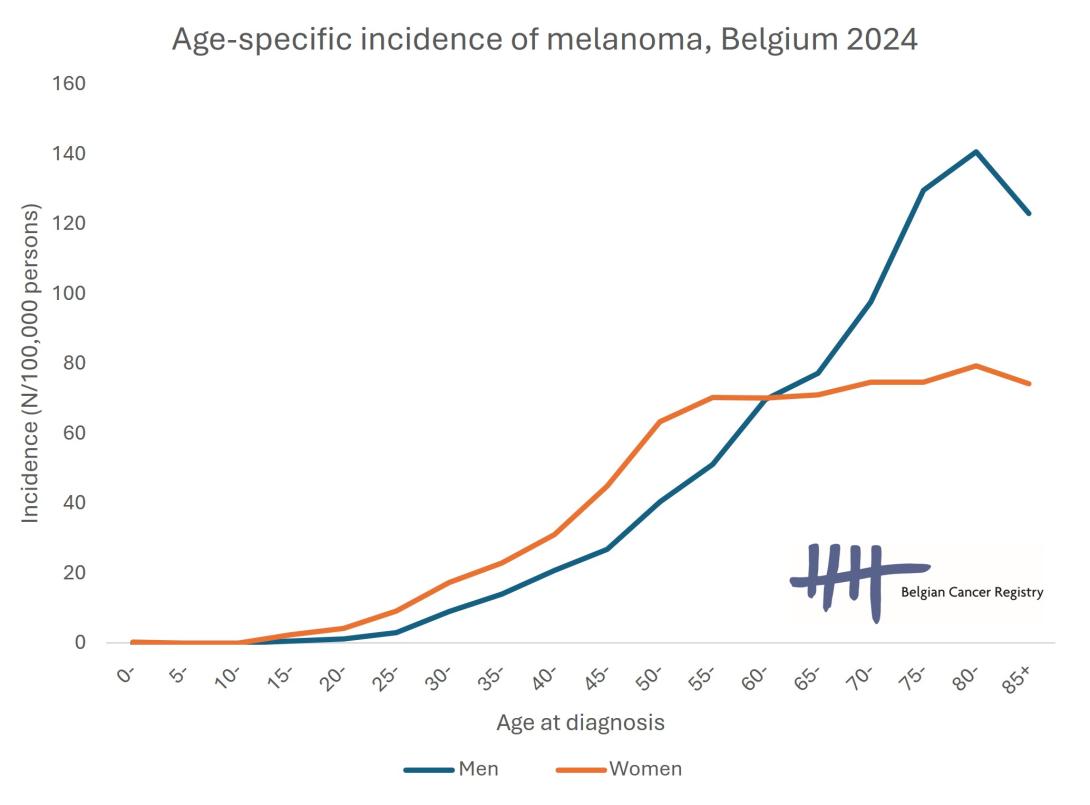
This overall trend masks important age-related differences. Before the age of 60, the risk of melanoma is higher among women. From the age of 60 onwards, the trend reverses and the risk becomes higher among men (Figure 2).
More and more melanomas are being detected at an early stage
The median tumour thickness (Breslow thickness) has decreased, a trend observed mainly in Flanders, where it fell from 1.0 mm in 2009 to 0.7 mm in 2024. Initially, thicker melanomas were more common there than in Brussels and Wallonia, but thanks to this favourable development, regional differences have now virtually disappeared.
Today, more than three out of four melanomas are diagnosed at Stage I, the earliest stage of the disease. Early detection significantly increases treatment options and directly contributes to a better prognosis.
Prof. Véronique del Marmol, Dermatologist at the Brussels Academic Hospital (HUB) and Euromelanoma:
"Early detection increases the chances of a favourable outcome. Raising awareness, regularly performing self-examinations of moles and skin lesions, monitoring individuals at increased risk, and ensuring rapid access to care when suspicious lesions are identified are all essential. Through Euromelanoma, we have been working towards these goals for more than 25 years."
More melanomas, but improving survival
Alongside the increase in incidence, prognosis has improved substantially. Five-year net survival among melanoma patients increased from 88% for diagnoses made between 2004 and 2009 to 96% for diagnoses made between 2020 and 2024.
Net survival reflects mortality attributable to cancer while excluding deaths from other causes.
Among patients with lymph node involvement (Stage III), five-year net survival increased from 59% for diagnoses made between 2004 and 2009 to 73% for diagnoses made between 2020 and 2024.
A significant improvement is also observed among patients diagnosed with Stage IV melanoma, when metastases are already present. In this group, five-year net survival increased from 27% to 39%.
Prof. Bart Neyns, Head of Medical Oncology at UZ Brussel:
"Thanks to breakthroughs such as immunotherapy, even patients with advanced melanoma are increasingly able to achieve long-term disease control and, in some cases, long-term survival. This illustrates how fundamental research and medical innovation directly contribute to improving survival prospects."
Prevention remains essential
The remarkable improvement in survival should not make us lose sight of the original challenge: the risk of melanoma in Belgium has more than doubled over the past twenty years.
Reducing excessive UV exposure, promoting sun-safe behaviours, identifying individuals at increased risk, detecting melanomas as early as possible, further improving treatments, and continuing to invest in research are complementary strategies for reducing the impact of melanoma in Belgium.
These priorities are fully aligned with the objectives of the new Cancer Plan 2026-2036.
About the Belgian Cancer Registry (BCR)
The Belgian Cancer Registry (BCR) collects and analyses data on all new cancer diagnoses in Belgium. These data form the foundation for epidemiological research, health policy support, and the evaluation of prevention and cancer care initiatives.

